Gen 1:11 And God said, Let the earth bring forth vegetation, the herbs yielding seed, and the fruit tree yielding fruit after his kind, whose seed is in itself, upon the earth: and it was so.
This word “seed” in Hebrew is zera‛ H2233 and it’s used exactly 229 times in the Old Testament, and the word for “seed” in Greek is sperma G4690, and is used 44 times in the New Testament, totaling 273 mentions in the Bible.
The first human beings were created by God. These particular humans, Adam and Eve, are not seeds. Adam was created by the hand of God from the dust of the ground and Eve was created by God from the side of Adam. It is the offspring procreated by Adam and Eve that are the seeds of all mankind.
Gen 2:7 And the LORD God formed man of the dust of the ground, and breathed into his nostrils the breath of life; and man became a living soul.
Gen 2:8-9 And the LORD God planted a garden eastward in Eden; and there He put the man whom He had formed. And out of the ground made the LORD God to grow every tree that is pleasant to the sight, and good for food; the Tree of Life also in the midst of the garden, and the Tree of Knowledge of good and evil.
There was only ONE commandment given to man before God created woman from his side to be his helper. Woman was not yet created when the LORD God gave man this commandment:
Gen 2:16-17 And the LORD God commanded the man, saying, Of every tree of the garden thou mayest freely eat: But of the tree of the knowledge of good and evil, thou shalt not eat of it: for in the day that thou eatest thereof thou shalt surely die.
*At this point in creation, there was no concept of death, because man was given the ability to eat from the Tree of Life and live forever.
Right after this command came, the Lord created Adam a fitting helpmate.
Genesis 2:21-25 And the LORD God caused a deep sleep to fall upon Adam, and he slept: and He took one of his ribs, and closed up the flesh instead thereof; And the rib, which the LORD God had taken from man, made He a woman, and brought her unto the man. And Adam said, This is now bone of my bones, and flesh of my flesh: she shall be called Woman, because she was taken out of Man. Therefore shall a man leave his father and his mother, and shall cleave unto his wife: and they shall be one flesh. And they were both naked, the man and his wife, and were not ashamed.
*Notice: there was no pro-creation as of yet. mankind had no fathers or mothers yet, and woman had just been created. The Lord God was the ONLY Father, so this was a prophecy spoken by Adam concerning how the procreation of SEEDS would be introduced and how it would proceed forward until the end of time.
Adam & Eve
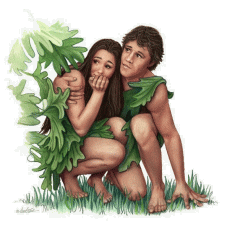
{Adam means: Red or Reddish & Eve means: Life or Living
Adam and Eve did not begin procreating until after the Fall and they were removed from the Garden of Eden.
In the 7th appearance of this word SEED in Genesis 3:15, we see it being spoken of as the offspring of God’s created humans.
Gen 3:15 And I will put enmity between thee and the woman, between thy seed and her SEED; they shall bruise the head, and you shalt bruise the heel.
*The way this verse actually reads in its original Hebrew is:
I will put enmity in the midst of woman, between SEED and SEED. It will bruise the head and you will bruise the heel. (*the enmity between SEEDS is what will bruise the head)
Look at this verse in comparison to what the Lord says to Rebekah about Jacob and Esau, a little later on in Genesis.
Gen 25:23-24 And the LORD said unto her, Two nations are in thy womb, and two manner of people shall be separated from thy bowels; and the one people shall be stronger than the other people; and the elder shall serve the younger. And when her days to be delivered were fulfilled, behold, there were twins in her womb.
Head means: the firstborn, chief or head
Heel means: the last, latter, or the youngest
Enmity ‘êybâh means: Opposition or hatred due to jealousy and is used only 5 times in the Bible.
Up until this point in history there were no SEED to put enmity between. No sibling rivalry because there were no siblings. It’s not until chapter four that we see procreation begin.
Gen 4:1-2 And Adam knew Eve his wife; and she conceived, and bare Cain, and said, I have gotten a man from the LORD. And she again bare his brother Abel. And Abel was a keeper of sheep, but Cain was a tiller of the ground.
The first SEEDS of mankind after the FALL and ejection from the Garden of Eden were Cain and Abel. Based upon the wording in the original Hebrew, it appears that they were twins.
The words conceive and bare in Hebrew are two distinctly different stages of the process of birthing, and in this event; there is only one occurrence of conception and two occurrences of birth.
Twins are very symbolic in the Bible. Jabal and Jubal, Esau and Jacob, Pharez and Zarah were all twins. Jabal and Jubal were the twin sons of Lamech, the 6th son born to Adam by the seed of Cain and their names mean: Jabal=streams of water and Jubal means=a single stream.
We can see that right after Cain and Abel’s birth, that *enmity sprung up among the first two SEEDS of mankind, just like the Lord told Eve in Gen 3:15.
Cain killed his twin brother Abel due to enmity caused by jealousy.
This is the first occurrence of violence among SEEDS, making THIS the start of the “enmity in the midst of the woman, SEED against SEED.”
Gen 4:8 And Cain talked with Abel his brother: and it came to pass, when they were in the field, that Cain rose up against Abel his brother, and slew him.
After this happens, there’s a separation that happens between the seeds of Cain, and the seeds of those that will choose to believe and walk with God.
Cain is sent away to wander in the land of Nod, which when properly translated means: “the land of wandering“, it’s the opposite and contrast to those walking with God.
Gen 4:25-26 And Adam knew his wife again; and she bare a son, and called his name Seth: For God, said she, hath appointed me another SEED instead of Abel, whom Cain slew. And to Seth, to him also there was born a son; and called his name Enos: then began men to call upon the name of the LORD.
Cain was cursed to wonder and Seth was appointed to have his SEED call upon the name of the Lord. Enmity was at work through the SEED of Cain, out of jealousy due to that favor of God on the lives of those that called upon and walked with God.
Violence due to that enmity spread among these SEEDS of mankind, and that is what caused the LORD to flood the Earth and start anew.
Cain=means: attain, acquire *Abel=means: breath, spirit (killed)
Enoch=means: dedicated Seth=means: appointed, chosen
Irad=means: fleet, army Enos= means: man or men
Mehujael=means: who is of God Cainan=means: a possession or fort
Lamech=means: powerful Mahalaleel=means: praised of God
Jabal=means: streams of water Jared=means: a descendant, descent
Jubal=means: a stream Enoch=means: dedicated
Tubalcain=means: brought of Cain Methuselah=means: man of the spear
Namaah=means: loveliness Lamech=means: powerful
Noah=means: peace, rest
It was the enmity/jealousy between the Seed of Cain and the Seed of Seth that caused the violence. According to ancient Jewish Rabbinic literature, the daughter of Cain, named Naamah, married Noah and had 3 sons.
Gen 6:9-10 These are the generations of Noah: Noah was a *just man and *perfect in his generations, and Noah *walked with God. And Noah begat three sons, Shem, Ham, and Japheth.
Shem
Ham
Japheth
Throughout the rest of this article I’ll be coloring seeds by this key above and I’ve put an *asterisk next to the words; just, perfect and walked with God, because it was these characteristics that made Noah stand out to God, and be the person chosen to repopulate the earth with the SEED of those that *walk with God.
The word just or righteous is used for the first time in Scripture in this verse above describing Noah, and in Hebrew the word is tsaddı̂yq H6662, and it means: just, lawful, righteous.
The word perfect is used for the first time in Scripture in this verse above describing Noah as well, and in Hebrew the word is tâmı̂ym H8549, and it means: complete, whole, entire, sound.
The words walked with God are used for the third time in Scripture, also in this verse describing Noah, and it’s used only two times prior in describing Enoch, Noah’s great grandfather. In Hebrew these words are: hâlak ‘êth ‘ĕlôhı̂ym. Which literally means; to walk with God, describing their belief and the manner in which a person traverses through life.
So, God chose a grandson of Enoch, the 7th from Adam of the SEED of Seth.
Noah walked with God, and was just and perfect, and it was for this reason, God chose to spare 8 from his household. It is only after the Flood that we start to see which of these SEEDS of Noah *walked with God and which would not.
~The FLOOD~
Shem, Ham and Japheth are the fathers of all the seeds of mankind after the Flood, according to biblical accounts.
Gen 9:9 And I, behold, I establish my covenant with you (Noah), and with your SEED after you;
We can see by the middle of Genesis chapter 9 that one of these SEEDS receives the first curse in the newly purged world, and it’s a curse brought about by the “sin of his father“, Ham.
Gen 9:25-27 And he said, Cursed be Canaan; a servant of servants shall he be unto his brethren. And he said, Blessed be the LORD God of Shem; and Canaan shall be his servant. God shall enlarge Japheth, and he shall dwell in the tents of Shem; and Canaan shall be his servant.
Shem had 5 sons. Elam, Asshur, Arphaxad, Lud and Aram.
Ham had 4 sons, Cush, Mizraim, Phut, and Canaan.
Japheth had 7 sons, Gomer, Magog, Madia, Javan, Tubal, Meshech and Tiras.
After the Flood, the violence between the seeds of mankind continued due to the seed of Canaan that has been cursed to be inferior to their brethren; they began raising up mighty hunters and warriors that they would make their kings and started to build cities among their territories with walls and watchtowers. They would attack and take over the neighboring territories of Shem and Japheth, and intermarry with their daughters. Shem had the name, and Japheth had the numbers. The tribe of Shem were the shepherds that lived in tents and tended to their flocks. The Tribe of Japheth held strength in the number of their descendants and the unity with their brother Shem.
God chose the seed of Shem (which means name) to establish His covenant with mankind, and selected a grandchild of Noah to continue to establish it upon the earth, choosing Abram, later named Abraham.
Gen 12:7 And the LORD appeared unto Abram, and said, Unto thy SEED will I give this land: and there builded he an altar unto the LORD, who appeared unto him.
Right here, From this verse on we will see Abram begin a testing to see if he will BELIEVE the Lord and as Gen 15:1 says “FEAR NOT”. God is specifically telling Abram in this verse above, that he himself as an old man, will not only bring forth SEED, but that SEED will be given those lands. Just two verses after God says this; Abram heads on his journey towards the south, and there is a great famine in that region, so Abram decides to go to Egypt to dwell there among their strength and protection, and THIS is where we start to see the Lord get really serious about not allowing ANYONE to bear seed with his wife Sarai. Take a look:
Gen 12:10 And there was a famine in the land: and Abram went down into *Egypt to sojourn there; for the famine was grievous in the land.
Now, take notice; the Lord just told Abram in verse 7 that He was going to produce SEED and that his SEED was going to possess all the land around him in the territory of the Canaanites; including the area he was passing through in Shechem; it was all included in the promise to him and his SEED.
YET, Abram chooses instead to push on and head in the direction of Egypt out of fear. Egypt was a well known place of strength and much substance but it WAS NOT part of the promised territories of Canaan that God had promised to him and his SEED, but rather Mizraim the son of Ham. It’s important to note that in verse 12:10 above; it’s the first time in Scripture that the word Egypt is used. Prior uses of the word in Gen 10:6 and Gen 10:13 have it translated as Mizraim, the second son of Ham.
We will see as a result of Abram’s choice to head in the direction of his fear and not trust in the promise of the Lord; that this turning to the strength of Egypt will be played out again a little later on in Genesis chapter 16 when Sarai his wife turns to an Egyptian handmaid in desperation and fear that her husband would not bring forth SEED, and as a result Hagar produced Ishmael due to that fear.
Heading to Egypt was the first mistake Abram made, proving he did not trust or believe in the promise of the Lord as of yet. The second mistake he made was looking to his wife to save his life and not trusting in the Lord’s promise to him. Abram asking his wife to conceal the fact that she was married and say she was his sister; which meant that she was available for another man to take as his wife. Abram knew this but feared for his life.
Gen 12:12 Therefore it shall come to pass, when the Egyptians shall see thee, that they shall say, This is his wife: and they will kill me, but they will save thee alive.
Gen 12:13 Say, I pray thee, thou art my sister: that it may be well with me for thy sake; and my soul shall live because of thee.
Gen 12:14 And it came to pass, that, when Abram was come into Egypt, the Egyptians beheld the woman that she was very fair.
Gen 12:15 The princes also of Pharaoh saw her, and commended her before Pharaoh: and the woman was taken into Pharaoh’s house.
Check this out: verse 16 in the KJV says “And he entreated Abram well” when it actually says in Hebrew, “It was more favorable for Abram” because he received sheep, oxen, servants and other things…
Gen 12:16 And he entreated Abram well for her sake: and he obtained sheep, and oxen, and he asses, and menservants, and maidservants, and she asses, and camels.
Abram thought things were all good until God made sure to put a STOP to things before Sarai was taken into another man’s bedchamber. Take a look:
Gen 12:17 And the LORD plagued Pharaoh and his house with great plagues because of Sarai Abram’s wife.
Gen 12:18 And Pharaoh called Abram, and said, What is this that thou hast done unto me? why didst thou not tell me that she was thy wife?
Gen 12:19 Why saidst thou, She is my sister? so I might have taken her to me to wife: now therefore behold thy wife, take her, and go thy way.
Gen 12:20 And Pharaoh commanded his men concerning him: and they sent him away, and his wife, and all that he had.
In chapter 13 we see Abram heading back the the territories of Canaan that he had passed over before he went to Egypt and this is where we see the first time the word STRIFE is used in Scripture. There was strife that rose up between the herdsmen of Lot and the herdsmen of Abram, and they separated and went in different directions, with Lot choosing to go to Sodom.
Gen 13:7 And there was a strife between the herdsmen of Abram’s cattle and the herdsmen of Lot’s cattle: and the Canaanite and the Perizzite dwelled then in the land.
Gen 13:8 And Abram said unto Lot, Let there be no strife, I pray thee, between me and thee, and between my herdsmen and thy herdsmen; for we be brethren.
Gen 13:12 Abram dwelled in the land of Canaan, and Lot dwelled in the cities of the plain, and pitched his tent toward Sodom.
Gen 13:13 But the men of Sodom were wicked and sinners before the LORD exceedingly.
Abram gave Lot the choice in verses 9 and 10 to go in whatever direction he wanted, and that he would go in the opposite direction. Lot chose to go east toward Sodom because it was lush and well watered, even though it was known that the men there were wicked and sinners before the Lord exceedingly as it says in verse 13.
Right after Lot chooses to head towards Sodom, the Lord tells this to Abram, and once again confirms His promise to him and his SEED.
Gen 13:14 And the LORD said unto Abram, after that Lot was separated from him, Lift up now thine eyes, and look from the place where thou art northward, and southward, and eastward, and westward:
Gen 13:15 For all the land which thou seest, to thee will I give it, and to thy SEED for ever.
Gen 13:16 And I will make thy SEED as the dust of the earth: so that if a man can number the dust of the earth, then shall thy seed also be numbered.
Gen 13:17 Arise, walk through the land in the length of it and in the breadth of it; for I will give it unto thee.
So Abram heads to Mamre a territory of Hebron in chapter 14 of Genesis, and we see the alliances of the kings of the SEED of Cain fighting over territories and Lot gets taken captive from out of Sodom and Abram has to go rescue him.
In Genesis 14:17 we see two kings come out to meet Abram after his great victory defeating the armies to obtain his nephew. The king of Sodom must have been detested by Abram because he was the king of the city where the men were evil and performed great wickedness. The other was the king of Salem, Melchizedek, which means peace, and he was also a priest of the Most high God. One king offered Abram bread a wine and spoke a blessing and confirmation of what the Lord had already told him. The other king only cared about what he could obtain from Abram’s great victory. We can clearly see the difference in SEED here in the actions of these two kings.
In Chapter 15 of Genesis it’s all about God’s covenant with Abram telling him to FEAR NOT, that HE will be his shield/protection and exceedingly great reward. Abram tells God of his unbelief about even having SEED, and the Lord tell him this:
Gen 15:5 And he brought him forth abroad, and said, Look now toward heaven, and tell the stars, if thou be able to number them: and he said unto him, So shall thy seed be.
Gen 15:6 And he believed in the LORD; and he counted it to him for righteousness.
Gen 15:7 And he said unto him, I am the LORD that brought thee out of Ur of the Chaldees, to give thee this land to inherit it.
If you take a closer look at Gen 15:6 in the original Hebrew it says:
‘âman (trust/believe) in the Lord, is châshab (calculated or counted) as righteousness.
“Trust in the Lord is counted as righteousness.” The yeast free version in Hebrew does not say He believed in the Lord, because we can plainly see in the next few chapters all the hardships Abraham faces that are due to HIS FEAR and lack of belief in the promise of God to him. Remember verse 1 of chapter 15 starts off with this command and promise to Abraham, “Fear not, Abram: I am thy shield, and thy exceeding great reward.” At the end of this chapter, the Lord reiterates his promise to Abram.
Gen 15:18 In the same day the LORD made a covenant with Abram, saying, Unto thy seed have I given this land, from the river of Egypt unto the great river, the river Euphrates:
In chapter 16 of Genesis we see Sarai, out of fear, look to the strength of Egypt, just like her husband did and she offers her Egyptian handmaid Hagar to Abram to bear seed for her husband. Hagar conceives and gives birth to Ishmael, a child that was born due to fear and doubt.
Gen 16:9 And the angel of the LORD said unto her (Hagar), Return to thy mistress (Sarai), and submit thyself under her hands.
Gen 16:10 And the angel of the LORD said unto her, I will multiply thy seed exceedingly, that it shall not be numbered for multitude.
Gen 16:11 And the angel of the LORD said unto her, Behold, thou art with child, and shalt bear a son, and shalt call his name Ishmael; because the LORD hath heard thy affliction.
Gen 16:12 And he will be a wild man; his hand will be against every man, and every man’s hand against him; and he shall dwell in the presence of all his brethren.
Gen 16:15 And Hagar bare Abram a son: and Abram called his son’s name, which Hagar bare, Ishmael.
Ishmael was half Hebrew from Abram and half Egyptian from Sarai’s handmaid Hagar, and the Egyptians were from the tribe of Mizraim, the son of Ham. It’s right after the birth of Ishmael that the Lord starts to get very specific about WHICH SEED are those who are the SEED of His covenant and will receive His promise.
Gen 17:3 And Abram fell on his face: and God talked with him, saying,
Gen 17:4 As for me, behold, my covenant is with thee, and thou shalt be a father of many nations.
Gen 17:5 Neither shall thy name any more be called Abram, but thy name shall be Abraham; for a father of many nations have I made thee.
Gen 17:6 And I will make thee exceeding fruitful, and I will make nations of thee, and kings shall come out of thee.
Gen 17:7 And I will establish My covenant between Me and thee and thy SEED after thee in their generations for an everlasting covenant, to be God unto thee, and to thy SEED after thee.
Gen 17:9 And God said unto Abraham, Thou shalt keep my covenant therefore, thou, and thy seed after thee in their generations.
Gen 17:10 This is my covenant, which ye shall keep, between me and you and thy seed after thee; Every man child among you shall be circumcised.
Gen 17:11 And ye shall circumcise the flesh of your foreskin; and it shall be a token of the covenant betwixt me and you.
This is a mark upon the flesh of every male child born from Abraham forward, as a memorial and sign to God and to man that they believed and walked with the God of Abraham.
Gen 17:15-16 And God said unto Abraham, As for Sarai thy wife, thou shalt not call her name Sarai, but Sarah shall her name be. And I will bless her, and give thee a son also of her: yea, I will bless her, and she shall be a mother of nations; kings of nations shall be of her.
Gen 17:17-18 Then Abraham fell upon his face, and laughed, and said in his heart, Shall a child be born unto him that is an hundred years old? and shall Sarah, that is ninety years old, bear? And Abraham said unto God, O that Ishmael might live before thee!
Gen 17:19 And God said, Sarah thy wife shall bear thee a son indeed; and thou shalt call his name Isaac: and I will establish My covenant, as an everlasting covenant, and with the SEED after him.
A whole LOT happens (pun intended) between the ending of chapter 17 and chapter 21 of Genesis, beginning with this verse above about Isaac being declared the promised SEED of God and not Ishmael, and Sarah being called the mother of those nations.
In chapter 18 we see the Lord confirm to Abraham once again what He spoke about his SEED and about Sarah bearing a child, Isaac, that would continue His covenant upon the earth; only this time, Sarah is overhearing it all within her tent, and gets caught for laughing in doubt about it because she was ninety years old. Sarah out of fear denies laughing, and is told quickly that she indeed laughed.
So in chapter 18, both Abraham and Sarah are given a promise and they have exactly 9 months to see it fulfilled as the Lord had said. Their trust/belief in the Lord is tested in those 9 months that lead up to Isaac being born in chapter 21.
Right after this scene, in Genesis chapter 18:16-22, the Lord turns His attention towards Sodom to judge it by destroying it and cutting off it’s inhabitants from the face of the earth. We read that the men there were wicked before the Lord, yet Lot somehow after being rescued by Abram in chapter 14 from Sodom, found his way back to Sodom, and had settled there and had given his daughters in marriage to the men of Sodom.
In chapter 19 we see Lot is married and has daughters in Sodom and sons in law, Some of Lot’s daughters married men of Sodom because it says he had sons in law in Sodom; but there were two daughters that are mentioned in Gen 19:28 that had not yet known a man. We see Lot offer these daughters to the men of Sodom to prevent them from defiling the messengers of God that were eating, drinking and lodging with them under the covering of his dwelling. Lot’s name in Hebrew actually means: covering or covered. Men at this time, desiring to dwell among a certain people or territory would give their daughters to their men in order to raise up offspring that would strengthen that people.
Lot had already integrated with the seed of Canaan in Sodom and was dwelling among them as one of them, but the Lord remembered the plea of Abraham and his promise to him at the end of chapter 18, that if even 10 *righteous (tsaddı̂yq H6662 the word used to describe Noah), men were found in Sodom, God would spare the city and it’s peoples destruction. The messengers sent by God did not find 10 righteous men, so the city and it’s inhabitants were destroyed, sparing only Lot, the son of Abraham’s brother Haran, his wife and his two daughters that had not yet been with a man.
Lot was given very specific instructions from the Lord to flee to the mountains and not stay within the surrounding areas, or he would be consumed.
BUT Lot said NO to the Lord, that he was afraid and feared for his life that some evil would befall him in the mountains and he begged to stay in this little insignificant city in Edom and the Lord agreed not to destroy this little city and titled it Zoar, which means: insignificant. Then in Gen 19:26 we see just as Lot is arriving to the safety of Zoar, the Lord begins destroying Sodom and Gomorrah, and his wife looks back and is turned into a pillar of salt. This is a monumental occurrence in the history of the Hebrews and will be the origin of the covenant of Salt later mentioned in Scripture that’s kept by the people of God as a memorial.
Lot and his wife had daughters and sons in law and possibly even grandchildren that were destroyed by the fire from God upon Sodom and Gomorrah. Many believe that she was turning back due to the longing for their ways, but it was in consideration of her daughters and sons in law and more than likely grandchildren that she was leaving behind to be destroyed by fire.
Jesus told us that whoever who has HAD to leave family to follow HIM; they would receive a hundred fold in this life and in the life after. This looking back theme mentioned here is mirrored in the New Testament book of Luke by Jesus Himself.
Luke 17:31-34 Likewise, no one in the field should go back for anything. Remember Lot’s wife! Whoever tries to keep their life will lose it, and whoever loses their life will preserve it. I tell you, on that night two people will be in one bed; one will be taken and the other left.
Luke 9:61-62 “I will follow You, Lord; but first let me bid farewell to my family. And Jesus said unto him, “No man, having put his hand to the plough, and looking back, is fit for the kingdom of God.”
Lot, when he ascended the mountain with his daughters out of Zoar due to his fear; he proved once again that due to those fears, he and his seed would NOT believe and walk with God and be obedient to His instructions.
Gen 19:30 And Lot went up out of Zoar, and dwelt in the mountain, and his two daughters with him; for he feared to dwell in Zoar: and he dwelt in a cave, he and his two daughters.
Lot, due to fear, fled to the mountains AFTER God had already told him he would spare the city of Zoar because of his previous fear, that some evil may befall him in the mountains and he would lose his life.
In doing this, Lot removed his daughters far away from the men of Zoar, in which the Lord had spared from destruction, and his daughters, in fear, took matters into their own hands and got their father Lot drunk with wine and lay with him to continue his seed upon the earth.
Gen 19:31 And the firstborn said unto the younger, Our father is old, and there is not a man in the earth to come in unto us after the manner of all the earth:
Gen 19:32 Come, let us make our father drink wine, and we will lie with him, that we may preserve seed of our father.
Gen 19:36 Thus were both the daughters of Lot with child by their father.
Gen 19:37 And the firstborn bare a son, and called his name Moab: the same is the father of the Moabites unto this day.
Gen 19:38 And the younger, she also bare a son, and called his name Ben-ammi: the same is the father of the children of Ammon unto this day.
So we can derive that these seeds of Moab and Ben-ammi were also born out of fear, just like Ishmael, and they will later assimilate with and become aligned with the people of Edom/Esau in the territories of those people that do NOT walk with God and become insignificant.
Once again in chapter 20 we see Abraham, newly named by the Lord and reaffirmed of God’s promise, head south in the direction of Gerar and he decides to lie once again to Abimelech, the king of Gerar, due to his fears, allowing his wife to be taken by him in order to spare his own life.
Gen 20:11 And Abraham said, Because I thought, Surely the fear of God is not in this place; and they will slay me for my wife’s sake.
Gen 20:12 And yet indeed she is my sister; she is the daughter of my father, but not the daughter of my mother; and she became my wife.
Gen 20:13 And it came to pass, when God caused me to wander from my father’s house, that I said unto her, This is thy kindness which thou shalt shew unto me; at every place whither we shall come, say of me, He is my brother.
Abraham at this point is still not trusting the Lord to preserve his life and his sins of his unbelief are being repeated and causing innocent people to suffer due to his fears for his life. Abraham had to pray for Abimelech and his people to be healed because God had closed up all of the wombs of the house of Abimelech while Sarah was kept in his quarters. Why, you might ask, did God close up the wombs of the women of Abimelech’s house? Sarah couldn’t get anyone pregnant, but Abraham could; and God wasn’t going to allow even one from the house of Abimelech to be impregnated by Abraham while his wife was taken into the home of another man. God made ALL the women barren, like Sarai’s previous state, to prohibit another Hagar, Ishmael situation taking place due to fear and doubt.
In chapter 21 we finally see “The Birth of Isaac” the promised seed.
Gen 21:1 And the LORD visited Sarah as he had said, and the LORD did unto Sarah as he had spoken.
Gen 21:2 For Sarah conceived, and bare Abraham a son in his old age, at the set time of which God had spoken to him.
Gen 21:3 And Abraham called the name of his son that was born unto him, whom Sarah bare to him, Isaac.
Gen 21:4 And Abraham circumcised his son Isaac being eight days old, as God had commanded him.
As soon as Isaac is weaned from his mother, Abraham has a great feast in his honor, and Sarah sees Ishmael begin to mock her son Isaac.
Gen 21:10 Wherefore she said unto Abraham, Cast out this bondwoman and her son: for the son of this bondwoman shall not be heir with my son, even with Isaac.
Gen 21:11 And this thing was very grievous in Abraham‘s sight because of his son.
Gen 21:12 And God said unto Abraham, Let it not be grievous in thy sight because of the lad, and because of thy bondwoman; in all that Sarah hath said unto thee, hearken unto her voice; for in Isaac shall thy SEED be called.
Gen 21:13 And also of the son of the bondwoman will I make a nation, because he is thy SEED.
The rest of chapter 21 is Abraham sending Hagar the Egyptian and her son Ishmael into the desert of Paran, God promises to make Ishmael a great nation and preserve his life, and Hagar takes a wife for Ishmael from the land of Egypt.
Chapter 22 of Genesis is all about God asking Abraham to offer Isaac, the promised SEED, as a sacrifice, to prove that He finally believes and trusts the Lord with not only his life but the life of his SEED.
Gen 22:16 And said, By myself have I sworn, saith the LORD, for because thou hast done this thing, and hast not withheld thy son, thine only son:
Gen 22:17 That in blessing I will bless thee, and in multiplying I will multiply thy SEED as the stars of the heaven, and as the sand which is upon the sea shore; and thy SEED shall possess the gate of his enemies;
Gen 22:18 And in thy SEED shall all the nations of the earth be blessed; because thou hast obeyed My voice.
Chapter 23 of Genesis is all about Sarah dying and being buried at the age of 127, and now Abraham will no longer be able to listen to all that she tells him, as instructed by the Lord in Gen 21:12.
Now, in chapter 24 of Genesis we see Abraham remembering what the Lord told him about his SEED and taking appropriate measures to assure that he walk in complete obedience to the Lord in choosing a bride for his son Isaac.
Gen 24:7 The LORD God of heaven, which took me from my father’s house, and from the land of my kindred, and which spake unto me, and that sware unto me, saying, Unto thy SEED will I give this land; he shall send his angel before thee, and thou shalt take a wife unto my son from thence.
Abraham sends his servant with this charge and relies completely upon the promise of the Lord to fulfill what He told him about his SEED.
Gen 24:13 Behold, I stand here by the well of water; and the daughters of the men of the city come out to draw water:
Gen 24:14 And let it come to pass, that the damsel to whom I shall say, Let down thy pitcher, I pray thee, that I may drink; and she shall say, Drink, and I will give thy camels drink also: let the same be she that thou hast appointed for thy servant Isaac; and thereby shall I know that thou hast shewed kindness unto my master.
Gen 24:15 And it came to pass, before he had done speaking, that, behold, Rebekah came out, who was born to Bethuel, son of Milcah, the wife of Nahor, Abraham’s brother, with her pitcher upon her shoulder.
Gen 24:27 And he said, Blessed be the LORD God of my master Abraham, who hath not left destitute my master of his mercy and his truth: I being in the way, the LORD led me to the house of my master’s brethren.
Gen 24:28 And the damsel ran, and told them of her mother’s house these things.
Gen 24:60 And they blessed Rebekah, and said unto her, Thou art our sister, be thou the mother of thousands of millions, and let thy SEED possess the gate of those which hate them.
Chapter 25 of Genesis is about Abraham dying, but before he does he separates his SEED and sets the SEED of Isaac apart from his other children born to him by Keturah.
Gen 25:1 Then again Abraham took a wife, and her name was Keturah.
Gen 25:2 And she bare him Zimran, and Jokshan, and Medan, and Midian, and Ishbak, and Shuah.
Gen 25:3 And Jokshan begat Sheba, and Dedan. And the sons of Dedan were Asshurim, and Letushim, and Leummim.
Gen 25:4 And the sons of Midian; Ephah, and Epher, and Hanoch, and Abida, and Eldaah. All these were the children of Keturah.
Gen 25:5 And Abraham gave all that he had unto Isaac.
Gen 25:6 But unto the sons of the concubines, which Abraham had, Abraham gave gifts, and sent them away from Isaac his son, while he yet lived, eastward, unto the east country.
Now, Chapter 26 of Genesis is all about Isaac and God continuing the covenant with him, as He did with his father Abraham. Isaac finds himself in the exact same situation as his father before Abimelech and has to choose to either follow his fears or to trust in the promise of the Lord.
Gen 26:1 And there was a famine in the land, beside the first famine that was in the days of Abraham. And Isaac went unto Abimelech king of the Philistines unto Gerar.
Gen 26:2 And the LORD appeared unto him, and said, Go not down into Egypt; dwell in the land which I shall tell thee of:
Gen 26:3 Sojourn in this land, and I will be with thee, and will bless thee; for unto thee, and unto thy SEED, I will give all these countries, and I will perform the oath which I sware unto Abraham thy father;
Gen 26:4 And I will make thy SEED to multiply as the stars of heaven, and will give unto thy SEED all these countries; and in thy SEED shall all the nations of the earth be blessed;
Gen 26:5 Because that Abraham obeyed my voice, and kept my charge, my commandments, my statutes, and my laws.
Okay, so you see right here, the Lord promised Isaac the same thing He promised Abraham. To bless him, to give him and his SEED those countries, and to multiply his SEED upon the face of the earth. Does Isaac trust God and His promise or will he fear for his life? Let’s see:
Gen 26:6 And Isaac dwelt in Gerar:
Gen 26:7 And the men of the place asked him of his wife; and he said, She is my sister: for he feared to say, She is my wife; lest, said he, the men of the place should kill me for Rebekah; because she was fair to look upon.
Gen 26:8 And it came to pass, when he had been there a long time, that Abimelech king of the Philistines looked out at a window, and saw, and, behold, Isaac was sporting with Rebekah his wife.
Gen 26:9 And Abimelech called Isaac, and said, Behold, of a surety she is thy wife: and how saidst thou, She is my sister? And Isaac said unto him, Because I said, Lest I die for her.
Gen 26:10 And Abimelech said, What is this thou hast done unto us? one of the people might lightly have lien with thy wife, and thou shouldest have brought guiltiness upon us.
Gen 26:11 And Abimelech charged all his people, saying, He that toucheth this man or his wife shall surely be put to death.
The sins of the fathers really plays out here. Once again before Abimelech, we see Isaac is willing to throw his wife under the bus in order to preserve his own life; just like his father Abraham did. Jesus came and laid down His life for His Bride, and these patriarchs are having to be tested to make sure they don’t use the excuse of “it was the woman you gave me” like Adam did, as a cover up for their own fears, doubts, disobedience and desires.
Now, in Chapter 27 of Genesis we see God bypass telling Isaac to “listen to everything she tells you” like He told Abraham concerning Sarah, and the Lord guides Rebekah how to assure that the RIGHT SEED is blessed by Isaac. Isaac favored his firstborn Esau because he was as great hunter and Isaac had a love for savoury meats. In other words; he had a proclivity to be led by his belly rather than the will of the Lord. We see Esau follow in this pattern, when he sells his birthright to Jacob to fill his belly. Gen 25:29-34
Let’s check it out: Here is Isaac speaking to Esau.
Gen 27:3 Now therefore take, I pray thee, thy weapons, thy quiver and thy bow, and go out to the field, and hunt me some game;
Gen 27:4 And make me savoury meat, such as I love, and bring it to me, that I may eat; that my soul may bless thee before I die.
Gen 27:5 And Rebekah heard when Isaac spake to Esau his son. And Esau went to the field to hunt for game, and to bring it.
Gen 27:6 And Rebekah spake unto Jacob her son, saying, Behold, I heard thy father speak unto Esau thy brother, saying,
Gen 27:7 Bring me game, and make me savoury meat, that I may eat, and bless thee before the LORD before my death.
Now pay attention to what Rebekah does:
Gen 27:8 Now therefore, my son, obey my voice according to that which I command thee. (Very much like the command that God gave Abraham concerning him listening to the words of his wife Sarah in Gen 21:12)
Gen 27:9 Go now to the flock, and fetch me from thence two good kids of the goats; and I will make them savoury meat for thy father, such as he loveth:
Gen 27:10 And thou shalt bring it to thy father, that he may eat, and that he may bless thee before his death.
Stop for a second. Do you see what happened here? God’s chosen SEED were the shepherds that tended the flock, they were not to be hunters like the children of Canaan.
If Rebekah had not instructed her youngest son to do what he did, Esau would be our patriarch and not Jacob. Rebekah remembered what the Lord had told her about her sons while she was pregnant.
Gen 25:23 “Two nations are in your womb, and two peoples from within you will be separated; one people will be stronger than the other, and the older will serve the younger.”
Gen 27:41 Esau held a grudge against Jacob because of the blessing his father had given him. And Esau said in his heart, “The days of mourning for my father are at hand; then I will kill my brother Jacob.”
Gen 27:42 When the words of her older son Esau were relayed to Rebekah, she sent for her younger son Jacob and told him, “Look, your brother Esau is consoling himself by plotting to kill you.
Gen 27:43 So now, my son, obey my voice and flee at once to my brother Laban in Haran.
Gen 27:44 Stay with him for a while, until your brother’s fury subsides—
Then Rebekah tells Isaac this, in order to send him to her brother Laban to fetch a bride for her youngest son Jacob.
Gen 27:46 Then Rebekah said to Isaac, “I am weary of my life because of these Hittite women. If Jacob takes a Hittite wife from among them, what good is my life?”
Gen 28:1 So Isaac called for Jacob and blessed him. “Do not take a wife from the Canaanite women,” he commanded.
Gen 28:2 “Go at once to Paddan-aram, to the house of your mother’s father Bethuel, and take a wife from among the daughters of Laban, your mother’s brother.
Gen 28:3 May God Almighty bless you and make you fruitful and multiply you, so that you may become a company of peoples.
Gen 28:4 And may He give the blessing of Abraham to you and your descendants, so that you may possess the land where you dwell as a foreigner, the land God gave to Abraham.
The next few chapters show us the tests that Jacob will have to endure to prove his trust in the Lord, and literally wrestle with God concerning his fear for his life. Jacob receives the same promise that Abraham and Isaac before him were promised, and he had to be tested to see if he would believe it.
Gen 28:12 And Jacob had a dream about a ladder that rested on the earth with its top reaching up to heaven, and God’s angels were going up and down the ladder.
Gen 28:13 And there at the top the LORD was standing and saying, “I am the LORD, the God of your father Abraham and the God of Isaac. I will give you and your descendants the land on which you now lie.
Gen 28:14 Your descendants will be like the dust of the earth, and you will spread out to the west and east and north and south. All the families of the earth will be blessed through you and your offspring.
Gen 28:15 Look, I am with you, and I will watch over you wherever you go, and I will bring you back to this land. For I will not leave you until I have done what I have promised you.
Are you beginning to see the repeated theme played out here with these 3 patriarchs? I hope you are. Watch this:
Gen 28:16 When Jacob woke up, he thought, “Surely the LORD is in this place, and I was unaware of it.”
Gen 28:17 And he was afraid and said, “How awesome/terrifying is this place! This is none other than the house of God; this is the gate of heaven!”
Gen 28:18 Early the next morning, Jacob took the stone that he had placed under his head, and he set it up as a pillar. He poured oil on top of it,
Jacob was where the Lord was; not the place he was residing in, nor the place that he had laid his head. There was no blessing given by God upon the place that Jacob was, but rather to him, and his SEED after him. These next few verses will give you some insight as to where Jacob’s allegiance was at this point in the story, concerning his belief in the Lord and His promise.
Gen 28:20 Then Jacob made a vow, saying, “If God will be with me and watch over me on this journey, and if He will provide me with food to eat and clothes to wear,
Gen 28:21 so that I may return safely to my father’s house, then the LORD will be my God.
In chapters 29-33 we can see the trust building events that Jacob faces in order to obtain the hand of Rachel from his uncle Laban, and the wrestle with his fears concerning his brother Esau. After Jacob worked for 20 years for his uncle Laban, and bore 11 sons and 1 daughter; he sets off with the 4 mothers of those children to head back to the land of his father Isaac, and has to face off with his brother Esau, whom he fears greatly.
Gen 32:7 Then Jacob was greatly afraid and distressed: and he divided the people that was with him, and the flocks, and herds, and the camels, into two bands;
Gen 32:8 And said, If Esau come to the one company, and smite it, then the other company which is left shall escape.
Gen 32:9 And Jacob said, O God of my father Abraham, and God of my father Isaac, the LORD which saidst unto me, Return unto thy country, and to thy kindred, and I will deal well with thee:
Gen 32:10 I am not worthy of the least of all the mercies, and of all the truth, which thou hast shewed unto thy servant; for with my staff I passed over this Jordan; and now I am become two bands.
Gen 32:11 Deliver me, I pray thee, from the hand of my brother, from the hand of Esau: for I fear him, lest he will come and smite me, and the mothers with the children.
Jacob split his family into two bands/companies due to fear: Rachel with Joseph, and Leah with her sons and daughter. This is why you will find that sometimes the phrase “children of Israel” and “children of Jacob” are used throughout the rest of the OT. It is because right here, Jacob split himself into two camps and is why his thigh gets dislocated by God, hindering his ability to stand and he limps upon that thigh from then on out. Jacob’s name is changed here by the Lord to Israel, and those children that believe and walk in obedience to God are referred to as the children of Israel. Jacob’s fear of his brother Esau at this point has caused him to refer to himself as Esau’s servant, and speaks of his brother as “his lord” while sending ahead of him droves of livestock in attempts to butter his brother up with gifts. God had already said that “the elder shall serve the younger”, so this readiness to submit himself to Esau as his servant, was contrary to the Word of the Lord to him. I would like to point out that the putting of ones hand beneath a man’s thigh is how the ancient Hebrews would bind a man by an oath to God according to that man’s future progeny. So it goes deep symbolically why the Lord dislocated Jacob’s thigh here.
Gen 32:24 And Jacob was left alone; and there wrestled a man with him until the breaking of the day.
Gen 32:25 And when he saw that he prevailed not against him, he touched the hollow of his thigh; and the hollow of Jacob’s thigh was out of joint, as he wrestled with him.
In Gen 33:2 we see that Jacob puts the handmaids and their children on the front line to be killed first if attacked, Leah and her children after, and Rachel and Joseph at the very back.
As we move into Genesis chapter 34 we’ll begin to see how this favoring of Rachel and her son Joseph causes Simeon and Levi, sons of Leah, to rise up to take matters into their own hands when it comes to the protection of their sister Dinah, and they killed Hamor and his son Shechem due to their sister being violated and treated like a harlot in their eyes.
Gen 34:7 And the sons of Jacob came out of the field when they heard it: and the men were grieved, and they were very wroth, because he had wrought folly in Israel in lying with Jacob’s daughter; which thing ought not to be done.
Gen 34:26 And they slew Hamor and Shechem his son with the edge of the sword, and took Dinah out of Shechem’s house, and went out.
Gen 35:5 And they journeyed: and the terror of God was upon the cities that were round about them, and they did not pursue after the sons of Jacob.
Now the Lord has already prophesied to Jacob that his name was no longer Jacob but Israel when he wrestled with God concerning his fear of his brother Esau; but Jacob still had not fully believed it, so the Lord had to tell him a second time, as well as once again reiterate His promise to him.
Gen 35:10 And God said unto him, Thy name is Jacob: thy name shall not be called any more Jacob, but Israel shall be thy name: and he called his name Israel.
Gen 35:11 And God said unto him, I am God Almighty: be fruitful and multiply; a nation and a company of nations shall be of thee, and kings shall come out of thy loins;
Gen 35:12 And the land which I gave Abraham and Isaac, to thee I will give it, and to thy SEED after thee will I give the land.
At the end of chapter 35 we see that Jacob loses his beloved Rachel as she gives birth to her second son Benjamin. Rachel knew prophetically as her soul was slipping from her body, that he would be the “son of her sorrow” as she named him Benoni, but it was Jacob that changed his name to “son of my right hand” which is Benjamin. Benjamin grows up to be referred to as a ravening wolf by his father Jacob in his blessing upon his sons before he dies, and later in Judges 20:14 we see that Benjamin goes to war against the children of Israel in rebellion against them. in Judges chapter 20. In chapter 21 we see as a result of their wickedness among their brethren, the men of Israel swear to not give their daughters as wives to the sons of the tribe of Benjamin, to stop the continuing of his seed among the children of Israel.
Gen 49:27 Benjamin shall ravin as a wolf: in the morning he shall devour the prey, and at night he shall divide the spoil.
Jdg 20:11 So all the men of Israel were gathered against the city, knit together as one man.
Jdg 20:12 And the tribes of Israel sent men through all the tribe of Benjamin, saying, What wickedness is this that is done among you?
Jdg 20:14 But the children of Benjamin gathered themselves together out of the cities unto Gibeah, to go out to battle against the children of Israel.
Jdg 21:1 Now the men of Israel had sworn in Mizpeh, saying, There shall not any of us give his daughter unto Benjamin to wife.
Jdg 21:6 And the children of Israel repented them for Benjamin their brother, and said, There is one tribe cut off from Israel this day.
Jdg 21:18 Howbeit we may not give them wives of our daughters: for the children of Israel have sworn, saying, Cursed be he that giveth a wife to Benjamin.
I know this has been a very lengthy article, but it takes all this scripture for a person to understand the importance of SEED, and how the Lord would preserve or pluck up certain SEED among the children that received the Promise of God to Abraham, Isaac and Jacob. I won’t draw it out much further, but I must interject a few verses from the NT with the illustrations that Jesus used to speak about the SEEDS sown by God and the Tares that the enemy sows in the midst of them.
Mat 13:24 Another parable put He forth unto them, saying, The kingdom of heaven is likened unto a man which sowed good seed in his field:
Mat 13:25 But while men slept, his enemy came and sowed tares among the wheat, and went his way.
Mat 13:26 But when the blade was sprung up, and brought forth fruit, then appeared the tares also.
Mat 13:27 So the servants of the householder came and said unto him, Sir, didst not thou sow good seed in thy field? from whence then hath it tares?
Mat 13:28 He said unto them, An enemy hath done this. The servants said unto him, Wilt thou then that we go and gather them up?
Mat 13:29 But he said, Nay; lest while ye gather up the tares, ye root up also the wheat with them.
Mat 13:30 Let both grow together until the harvest: and in the time of harvest I will say to the reapers, Gather ye together first the tares, and bind them in bundles to burn them: but gather the wheat into my barn.
Mat 13:31 Another parable put he forth unto them, saying, The kingdom of heaven is like to a grain of mustard seed, which a man took, and sowed in his field:
Mat 13:32 Which indeed is the least of all seeds: but when it is grown, it is the greatest among herbs, and becometh a tree, so that the birds of the air come and lodge in the branches thereof.
Mat 13:36 Then Jesus sent the multitude away, and went into the house: and his disciples came unto him, saying, Declare unto us the parable of the tares of the field.
Mat 13:37 He answered and said unto them, He that soweth the good seed is the Son of man;
Mat 13:38 The field is the world; the good seed are the children of the kingdom; but the tares are the children of the wicked one;
Mat 13:39 The enemy that sowed them is the devil; the harvest is the end of the world; and the reapers are the angels.
Mat 13:40 As therefore the tares are gathered and burned in the fire; so shall it be in the end of this world.
Mat 13:41 The Son of man shall send forth his angels, and they shall gather out of his kingdom all things that offend, and them which do iniquity;
Mat 13:42 And shall cast them into a furnace of fire: there shall be wailing and gnashing of teeth.
Mat 13:43 Then shall the righteous shine forth as the sun in the kingdom of their Father. Who hath ears to hear, let him hear.
I pray that everyone that reads this understands how SEED and TARES are different. Those who believe God and have faith if what they believe by their obedience to His Word, because it is those SEEDS that are the SEED of His Promise.
If you made it to the end of this article, I pray you get out your Bible and check every thing I have written.
May you be Free, and Set Free in Jesus name!
God bless you.
 Red Letter Publications